All posts by Asia Reveal Tour Laos

Boun Khao Phansaa

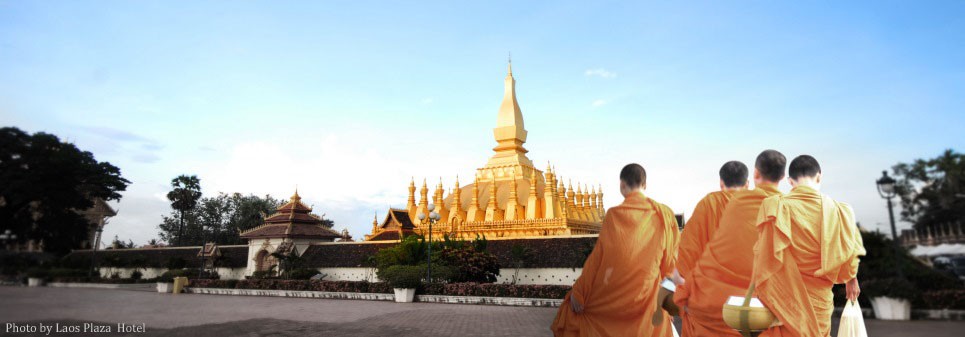
Boun Khao Phansaa, which marks the beginning of “Buddhist Lent”, is celebrated yearly on July. A legend said that, there was once a group of six monks walking during the rainy season. They were careless about where they put their feet, stepping on frogs and crushing new rice plants. This angered the farmers who complained to the Buddha. The Buddha made the rule for the Sangha, the community of monks, to observe Khao Phansaa, which means “entering the rainy season.” The traditionally lay people are not allowed to get married until the end of the Buddist Lent which is less making parties during three months Khao Phansa. Many take time away from work to make merit for deceased relatives. They also offer robes to become novices or monks.
During this time devout people often abstain from alcohol. They pray for assistance and guidance to encourage merit and happiness in their lives. It encourages them to follow the five major Buddhist vow to follow the precepts (five rules of conduct):
· You shall not kill lives
· You shall not steal or cheat
· You shall not commit adultery
· You shall not lie
· You shall not consume alcohol or drugs

The rule is that for three months during the rainy season the monks must vow not to stay overnight away from their temple, unless they have permission for special circumstances such as visiting sick parents, going to deliver sermons. In any case, they can never be gone more than seven days.
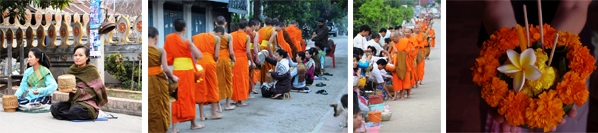
Alms-giving2-Asia-Reveal-ToursOn the first day of the waning moon, People do Tak baat (Alms offerings) of food (particularly khaotom, rice, banana or pork wrapped in banana leaves) and donate necessities like soap, toothpaste and toothbrushes and towels for the monks. Most temples are very busy during this time with people making merit and giving their donations. At the end of these merit-making activities the monks will recite the teachings of Buddha and tell the history of Lent to temple goers., take the precepts, and listen to a sermon. After the evening prayers, the novices and monks make their vows to stay in their wat and kuti or monk living quarters , residence, for the three rainy months.
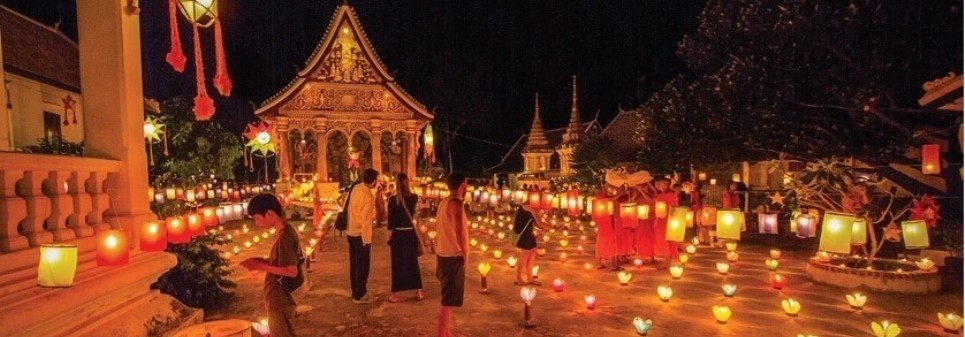
On the full-moon day of the eighth lunar month people go to the temple with incense sticks, candles, and Pha Ab Nam Fon (a yellow robe for bathing) and offer them to the Buddha statue in the temple. After that, they perform the prayer/chanting ceremony and listen to a sermon. Later in the evening monks, novices and laypeople bring flowers and candles and walk around the central temple three times in a ceremony known as Vien Thien in Lao.

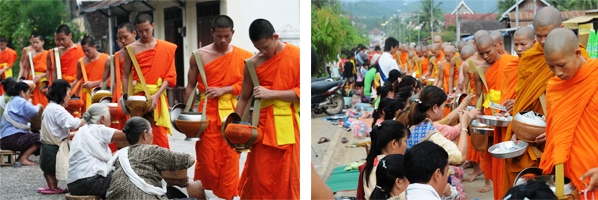
Morning Alms Giving – A great culture, not the show

The ritual of alms-giving ceremony (Tak Bat) is a ceremony that takes place all day at dawn when the monks get out of their temples to collect offerings from local people. This traditional ceremony is most famous in Luang Prabang – the former capital of Lane Xang, which has 33 ancient Buddhist temples in a total area of 25 ha.

Alms-giving-Asia-Reveal-Tours

Main features:

Time: Daily at 4: 30 or 5:00 AM
Location: Along all the streets
Where: Nationwide
Offerings: Sticky rice, candies, cookies, Khao Tom (sticky rice steamed inside banana leaves), milk, etc…
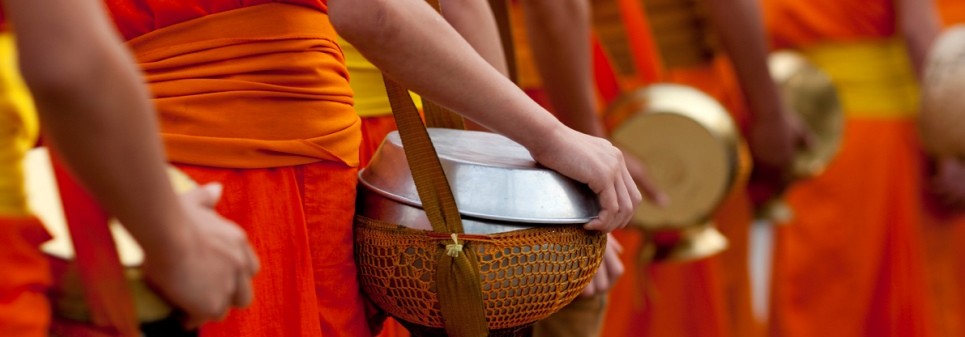
Alms Giving Ceremony is held at 4:30 or 5am daily morning. Women dress in traditional way, shoulder is rounded with sweat cloth and flower’s put on hair. Everyone brings food, which is prepared and laid carefully on a silver tray, or in rattan basket, sits on the roadside and wait for silent lines of saffron-clad monks walk down the streets of Luang Prabang to collect alms. The monk pass one by one in front of the devotees and the faithful at the same time, delivered the offerings with their own hands by inserting food inside the metal container that the monks carry. The ritual is done in silence; the monks walk in meditation, and the almsgivers reciprocate with respect by not disturbing the monk’s meditative peace, even when they pass already.
The ceremony is truly an important tourist attraction because of its beauty. However, this is a culture, not a show, being maintained for thousand years.  When tourists don’t know about the customs, their clumsiness can disrupt this ceremony.
Alms-giving2-Asia-Reveal-ToursTips for traveler when attending Tak Bat:
•    Observe the ritual in silence and contribute an offering only if it is meaningful for you and can do so respectfully.
•    Please buy sticky rice at the local market earlier that morning rather than from street vendors along the monk route.
•    If you do not wish to make an offering, please keep an appropriate distance and behave respectfully. Do not get in the way of the monks’ procession or the believers offerings.
•    Do not stand too close to the monks when taking photographs; camera flashes are very disturbing for both monks and the lay people.
•    Dress appropriate: Shoulders, chests and legs should be covered.
•    Do not make physical contact with the monks.
•    Do not position yourself so your head is higher than the monks’ heads.
•    Do not make eye contact with the monks.
•    Do not touch the monks’ bowls while placing your offerings.

Savannakhet’s Beungva, a great place to visit

If you go to Savannakhet province and have no idea where to go, Beungva marsh is one of the more popular places for people who love eating fish and sightseeing.
Beungva is a beautiful natural tourist site, located in Beungva village, Kaysone Phomvihane district. It is located in the eastern part of the capital of the province about 8 km from the centre. The area provides a water reservoir for local farmers to do dry season rice farming.
In addition, Beungva is also a place for local fishermen to catch aquatic creatures such as fish, shrimp, crabs and snails.
At this time of year, a visit to Beungva should be an amazing experience as you will be rewarded with fresh air and wind blowing through the hut you are sitting in.

Savannakhet 2In addition to a cooling dip, make the most of the freshwater fare yielded up by the swollen waters of the reservoir. The dry season brings a low in the level of the reservoir and rivers, and fishermen in nearby villages spend the whole day catching fish to sell at restaurants around the reservoir.
It is realized that the air and a gentle breeze were rising from the reservoir. Beungva looks like a small sea.
There are more than 40 huts along the small road passing through Beungva Village to be for lunch with quickly offered services. Various Lao foods have consisted and requested European dish. Grilled fish with papaya salad is as a famous favour.
While in the area, visitors are also advised to take time to see Vat Xayaphoum, That Inhang, and the dinosaur museum.

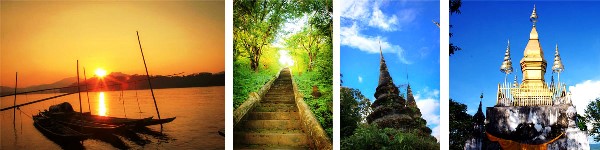
Top ideal places to enjoy sunset in Luang Prabang

Luang Prabang performs its attraction not only by its friendly people and nice landscape, but also overwhelmed tourists by the stunning of Mekong River over the sunshine. If you are such tired of sitting on car every time, or being heated all day on the road, let’s take a relaxation by a simple book, street fruit shake and straight your foot somewhere, enjoy the sunset, it may treat you well!
So, where can be your ideal place for sunset view? Take a look on below advises and you may need it during this summer!

1.    Phousi Mountain
This place should be in the top of must-sees in Luang Prabang. For both local residence, and tourists, Phousi Hill is famous of its holy legend, and a small challenge with 328 steps, for those want to obtain the panorama view of whole ancient city and rivers. Of course, the best time enjoy sunset there, is from 5:00 to 5:30 in dry season (October to April) and 5:30 to 6:00 in rainy season (May to September).
Local people often buy some flower (frangipani or marigold), set on the ground as the offerings, and a small bird to release, wishing for the good luck, peace and happiness in the future.
After relax, visit ancient stupa of Wat That Chompsi, you could go down, enjoy your time of Night Bazaa exploration, or wandering along the street, cross Wat Sene at 06:30 pm and see the monks start to intone, among the holy sounds of bell, drum, while the last lights’ falling on the road.

Phousi - sunset2.    Bamboo Bridge to Dyen Sabai Restaurant
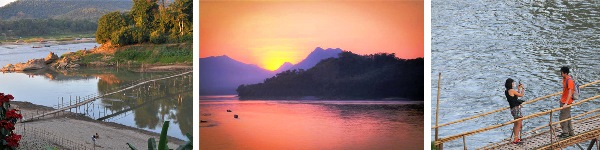
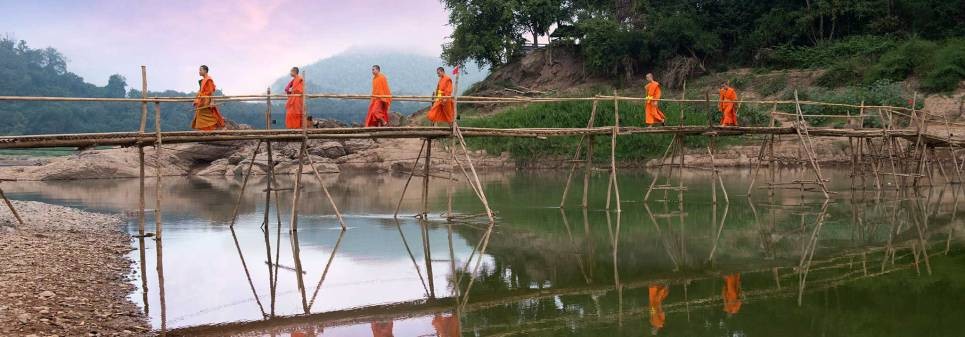
Enjoying sunset view on Bamboo Bridge is quite special and unforgettable. For who never step into a bamboo bridge, it could be a bit scared. However, it is totally not dangerous, if you pay attention and stick tightly to the handrails.
Crossing the bamboo bridge during the sun downs gives you a chance to see how the water changes its color into silver and golden. Watching fisherman and local people finish their daily work along the bank, and relax with the plenty perfume of herbs, oils from Dyen Sabai Restaurant & Spa.
The Bamboo Bridge is only presented during dry season, till the end of May, when the water level is lowest. The entrance fee is 5,000LAK per time, per person.

Bamboo bridge Luang Prabang
3.    “Mekong Beach”
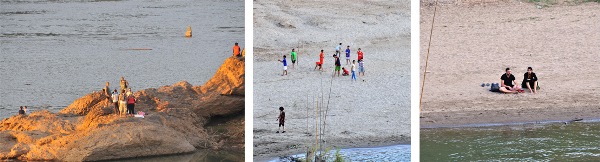
“Mekong Beach” is the way people calling the sand ground lying along Nam Khan River and Mekong River, near Bamboo Bridge in Dyen Sabai. This large beach is quite dry during summer and people often come to play game, organize picnic weekend or some football, ultimate Frisbee (for foreign community).
If you want to spend some wandering, take some drink, and get down stair at the Burasary Café & bakery. Late afternoon is most suitable, when the weather is cooler, and you could see the sun downs in a pleasant and authentic way.Mekong beach

4.    Wat Prabath
Wat Prabath (or Chùa Phật Tích) is on the way to Phousi Market. This is one of the most unique, and perhaps somewhat garish, of Luang Prabang’s monasteries, as it combines elements of Thai, Lao and Vietnamese religious architecture. The Wat is on a site overlooking the Mekong River and is to the southwest (downstream) of Luang Prabang so “Sunset view” could be the most common phrase of people when coming there.
5.    Utopia Bar
Well, the most (probably) famous bar for foreigners in Luang Prabang, could be the Utopia. Whose ideal location on the bank of Nam Khan River, overlook to Old Bridge, stylish decoration with cozy atmosphere, plenty choice of drinks and snacks, Utopia is the highlight of almost “Sunset Tour” for those dream of a lazy treatment. When the light on is time for a small yoga club outdoor. You could attend with 50,000LAK per time, or continuing your chat as an audience is no problem!
6.    Nava Mekong Cruise
Nava Mekong Cruises offers you a package of dining while sunset. With a reasonable price, you could easily book a table on the fully-equipped traditional boat, cruising on the Mekong River, enjoy dinner and plus traditional dance with a large view of Mekong during sunset.

Sunset view
7.    Maison Dalabua Terrace Pond View
Maison Dalabua Terrace Pond View is one of my favorite places when I pass the Photisath Road at the sunset time. This open bar is pretty easy to access and appalling enough for some soft drinks before dinner. The pond with wooden bridge-road, flowered by seasonal lotus and water lily brings a boutique feeling for everyone in such a touched afternoon. I assure you could see the sun shadow on the surface, otherwise, after some beers, you may believe that!

Nangsangkhan – Highlight of Laos New Year

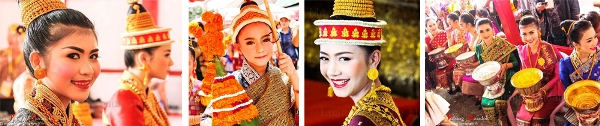
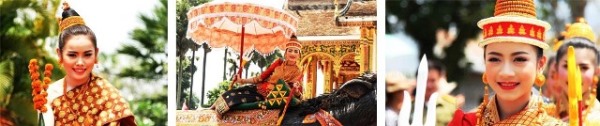
Boun Pi Mai, or Lao New Year is a three-day celebration, which is taken place from April 13-15 every year.  During these days, there are lots of themed activities, as well as cultural ceremonies, being officiated. One of those highlights, which can be found in the two biggest cities – Vientiane and Luang Prabang, is Nangsangkhan pageant.

Nangsangkhan pageant, or Miss Pi Mai Lao, or Miss Lao New Year, is famous by its own attractions from organization, candidate’s reputation, and a huge paradise on the street to show the respect, on the main day of Laos New Year.

Miss Pi Mai 2015 small

Photo ©: Luang Prabang Moradock

Approximately from middle of March, normally 15 – 21st March, the committee will select the candidates for Miss Laos New Year. More or less of twenty-five beautiful girls around the city will be announced supporting by any organizations. Only seven contestants will be selected within the first winner is called Nang Sang Khan of this year. The reason why seven contestants, neither less than, nor more than, is because each person will symbolize for one of King Kabinlaphrôm’s seven daughters according to the Lao legend.

Nangsangkhan 2015Photo ©: Luang Prabang Moradock

The contest is annually held at the Deun That or old stadium, Luang Prabang Province between11th – 12th nights of April; and Vientiane with the same time, at selected venue every year.

All the candidates have to prove themselves by 03 rounds. And the support from fans and crowds is also the important key for the champion. After selected, Nang Sang Khan will represent the tutelary spirit of the New Year in luxurious styles clothing. She performs in the main parades mounted on the huge animal statue (the holistic animal sign of the year) and surrounded by her fellow contestants.

Laos Hotel updates in April 2015

  • The Grand Hotel (Luang Prabang) continues renovations and refurbishment project for the rooms, lobby, museum, meeting rooms. The project is expected to complete by October, 2015.
  • My Dream Resort (Luang Prabang) has recently completed 02 Bungalow Dream; 01 Bungalow Suite, and 01 Bungalow Family. All the new rooms are ready to used from 01 May, 2015.
  • Kamu Lodge (Luang Prabang) announced new policy from March 2015. Then, the package will be divided into accommodation, boat trip, activities and guide separately. Each service will be charged per tent, not per person as before.
  • Nava Mekong boat (Luang Prabang) will settle yearly maintenance from Monday 15th to Friday 26th of June 2015 (inclusive). All the bookings drop into this period will not be operated.
  • Laos Plaza (Vientiane) starts new refurbishment project for regular floor (4th floor only) from March 15, 2015. The project is expected to complete by the end of August, 2015.