All posts by Asia Reveal Tour Laos

Travel to the South during low season, why not?

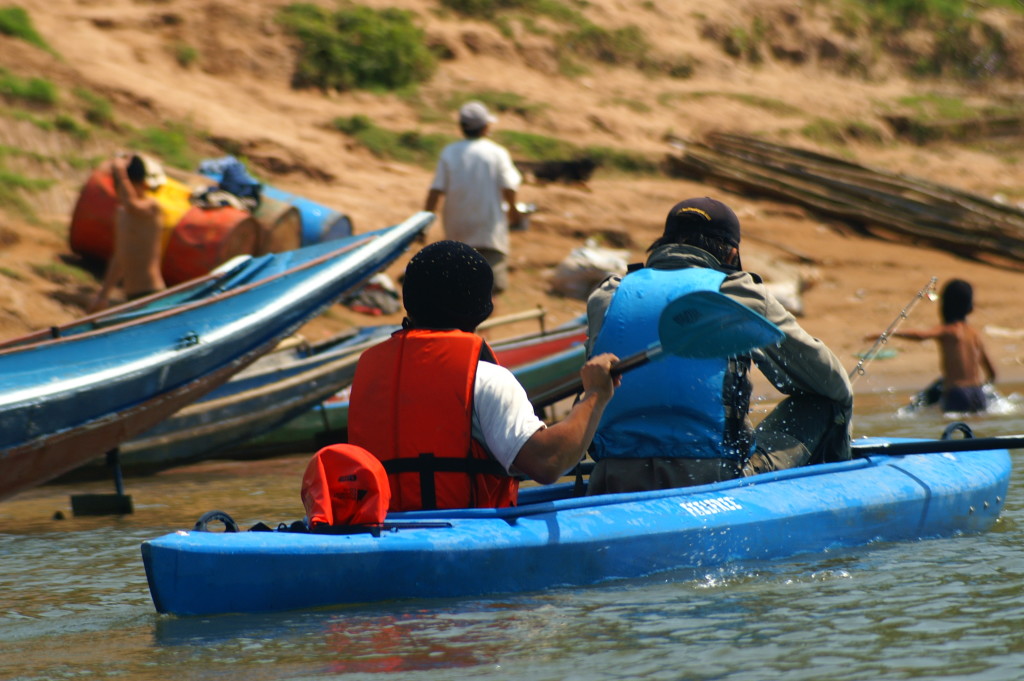
Why do I like travelling in the rainy season in the southern islands of Laos in Champassak province? Well because it’s much less crowded than high season, the natural scenery is verdant and green, the fishermen are out on the water and the guesthouses are cheaper as well.
OLYMPUS DIGITAL CAMERA
Oh but of course there is the small risk of rain which could make travel to some tourist sites more difficult but if you are well prepared and equipped with a rain coat and an umbrella then there should be no problem really.
In the rainy season, the south is not crowded with tourists seeking to v isit the two peaceful islands of Done Det and Done Khone but tourists who do travel in this season can certainly enjoy the greenery of nature while eating and sleeping will also set you back a little less.
It is three hours by bus from Pakxe, the capital of Champassak, to Done Khone to reach Nakhasang village before you have to pay 20,000 kip for a boat ticket to reach either of the two islands.
The rainy season in Laos runs from June until October, during which time the water level in the Mekong is much higher and you can see local people in Done Det and Done Khone especially during this season you can see utilising boats as their exclusive form of transportation.
Now is an especially good time for tourists to enjoy watching the lifestyles on the river and how the fishermen go about making their living.
The villagers depend on fishing for their livelihoods, with much of the fish caught being sold to provide income. Currently, people living on the two islands are also entering into business to serve tourists since the area became known to the international travelling community in the early 2000s.
Done Det and Done Khone are well known islands to relax with the slow pace of life, and touch the simple lives of the people, who live in tune with and depend on the surrounding natural environment.
However, you may be disappointed if you have heard about sunbathing on the beach with buffalo on Done Det, as the river is up and the beaches have disappeared. But the buffalo remain and you still can see them wallowing in the muddy shallows of the Mekong at the end of the day.
Done Khone and Done Det offer beautiful sunsets made more entrancing because you can experience them while walking along the islands, often seeing the local children swimming in the river.
Getting up early to watch the spectacular sunrises will let you see the local fishermen standing in their boats and hauling in the nets they set out the night before.
The islands also offer visitors the opportunity for tourists to learn how to be farmers, planting vegetables and rice, or traditional methods of fishing.
As the two islands are developed as tourist sites, visitors will not be concerned if they need to connect with the world, as restaurants, bars, bungalow and guesthouses now offe r visitors with free Wifi.
If you love peace and tranquility and want to escape from technology, you should try to ensure that you sleep in a bungalow close to the river, and then pick up your favorite book to read while relaxing in one of the many hammocks in the breeze.
A gentle breeze will also be your companion all night, the fresh air helping you to relax into a deep sleep.
The sound of the speedboats that the locals use to take their produce to the market as well as their children to school in the morning may act as an alarm clock, but by far the best way is to rise early so you can see these activities for yourself.
Travelling to the islands in the low season, you can take advantage of sleeping cheaper as guesthouses and bungalows lower their prices by almost 40-50 percent, at 40,000-50,000 kip per night, while the air is fresh and the surrounding greenery cools the air.
KONICA MINOLTA DIGITAL CAMERAThere are still the same activities available during the high season, it is just different as tourists can’t sunbathe on the beach, which is a well-known activity on Done Det.
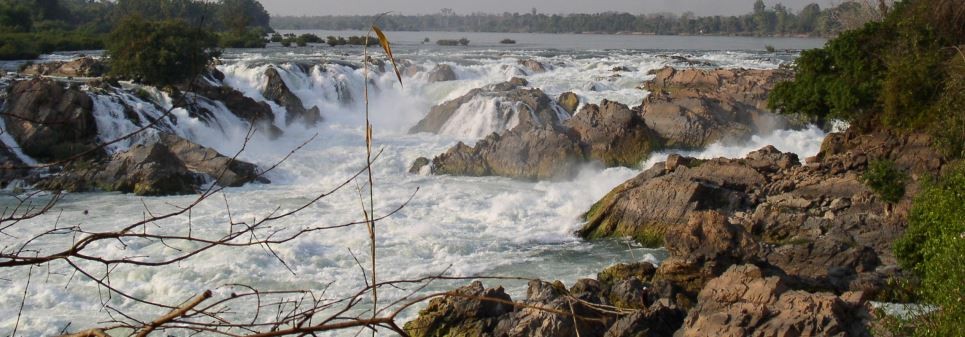
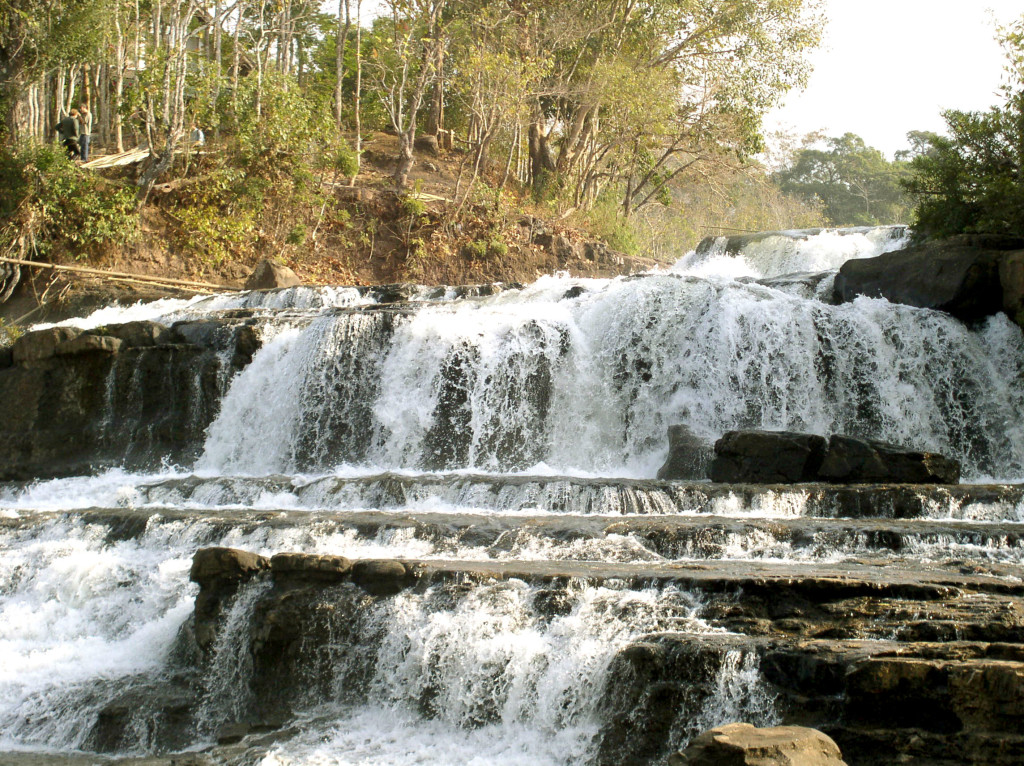
Visitors can spend two or three days to rent a bicycle or walk the four kilometres to visit Lyphi waterfall at Done Khone. At this time the waterfall will be much more beautiful with the large volume of water but it might be a muddy shade of brown.
Riding by bicycle through the island communities will help you to learn how locals’ lives pass, while on the road to the waterfall, you will fall in love with the rice paddies where local farmers are planting and the big shady trees will invite you to take a rest from pedaling.
Next to Lyphi waterfall, only around 2km away, you can hire a boat man at 15,000 kip per ticket to look out for Irrawaddy dolphins ( Pha ka), which are often sighted near the Cambodian border.
Tourists will spend one hour at the Cambodian side, before the boat man will glide in with the motor off so you can get closer to the pha ka pool without disturbing them. Of course, it is a great thrill for those who get to see the dolphins break the water.
Following healthy pursuits, tourists can enjoy swimming in the river or jogging around the islands, but if y ou love relaxing with drinks, Beer Lao or Lao khao (sticky rice alcohol) they are also available here, before you go to sleep with the sound of the cool breeze, insects chirping and the wind in the trees.
Most of all, finding real happiness lies in staying with the hospitable and friendly villagers of the laidback southern islands.

By Ounkham Pimmata

Survey for a new boat trip service between Laos – Thai

Luang Prabang province’s Public Works and Transport Department deputy director, Bounkhong Souksavat, told Vientiane Times that the project had the potential to improve the living standards of communities on the river.

The river trip from Luang Prabang to Chiang Khan district in Loei province would span 290 km, while the same journey by road covers 410 km. There are no regular tourist related river trips on this section of the river.

The only established river trip, that attracts international tourists, starts in Huay Xai on the border with Chiang Khong in Chiang Rai province and passes through Pak Beng on the way to Luang Prabang.

inside no 1The deputy director said: “Lao and Thai consultants will join a Lao team to survey the currents, volume of water, depth and other factors that would determine if boat tourism is feasible. They would also study seasonal phases of the river to ensure year-round safe navigation .”

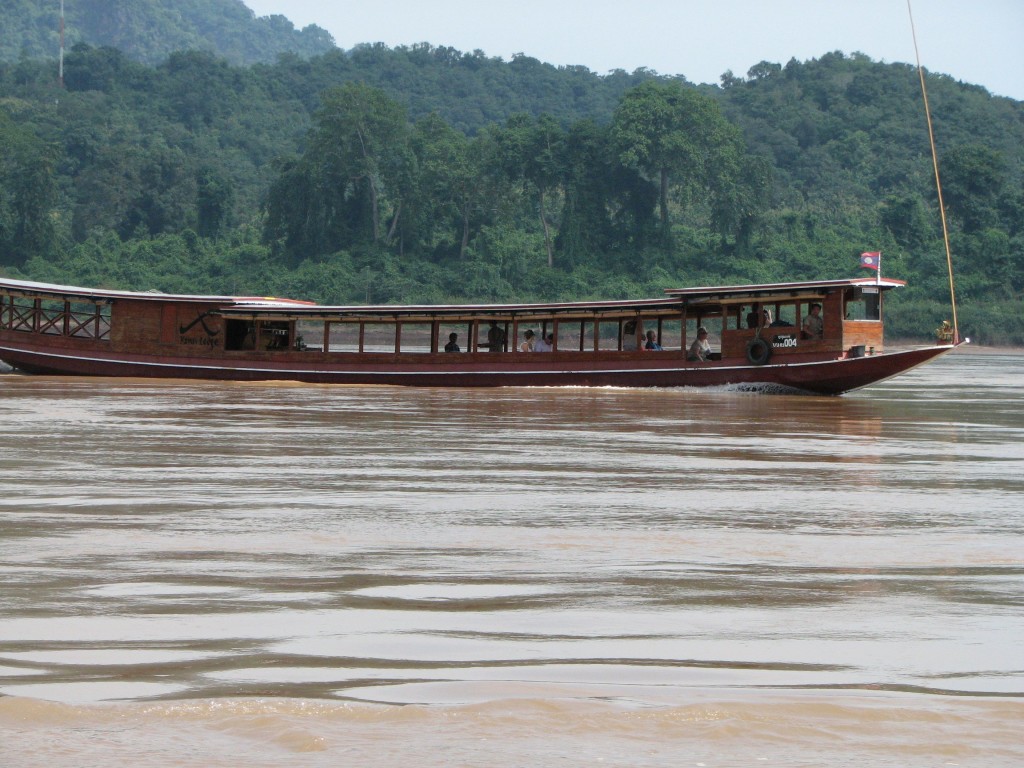
Kamu Lodge Boat

The big issue of water volume relates to upstream dams.  The control dams have over water flow makes it difficult for locals to determine accurately safety margins for boat drafts. The river is now artificially controlled and this means long stretches of the river from Luang Prabang may not be navigable year-round, or the level could drop significantly without much warning.

Authorities of Loei province, Thailand, recently toured Luang Prabang with their Lao counterparts to investigate the concept of opening tourist riverboat services.

At a recent meeting, officials agreed to use technical consultants from Chulalongkorn University, Thailand, along with Lao consultants for the survey. The survey will be completed by the end of the year.

Boun Khao Phansa celebrated in Laos

“The festival is an important opportunity to make merit for me and my family. I usually join my mother to attend almsgiving at the temple every Buddhist Lent,” a resident of Phonsinuan village named Ms Kaikeo said after she finished presenting her offerings.
This was her special day as she had to get up at 5am to prepare her offerings for the monks and novices for Boun Khao Phansa.
The monks told her that her actions were one way to seek mindfulness and happiness in this life and the next, but it is also about making merit for spirit relatives and those who transgressed or acted badly in a past reincarnation.
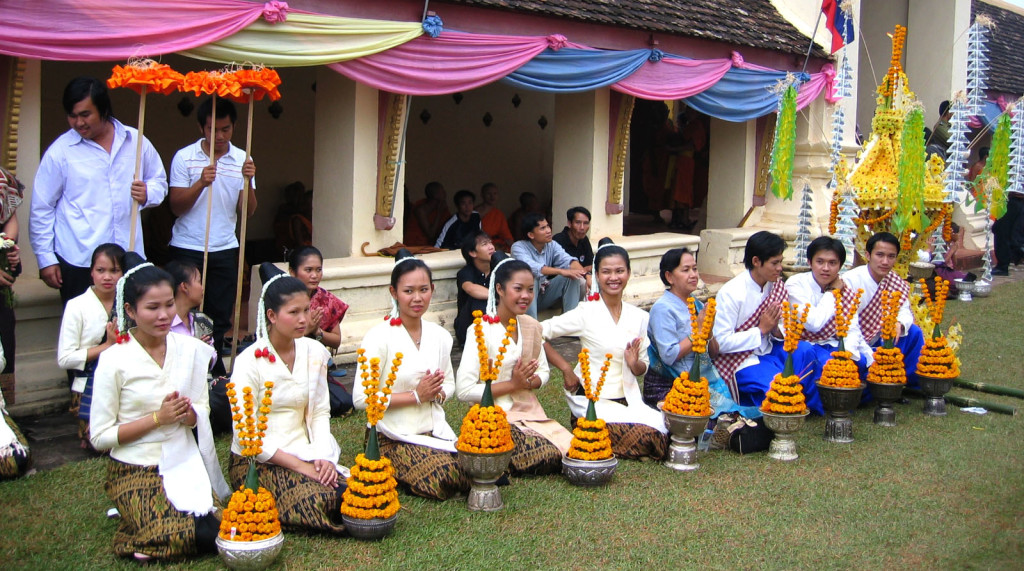
Each year of Buddhist Lent (Boun Khao Phansa ) believers get up early to take their buckets with offerings and a couple of large candles to go to the temples at seven in the morning.
These offerings will provide convenience for the monks and novices during the three months of studying the Buddha’s teachings, keeping the precepts and pausing for meditation.

Baci ceremony
At 8am, senior monks in local temples gave five commitments to lay people to encourage them to make merit and give blessings.
After that believers are allowed to give arm directly to monks, before they sprinkle water from a small bottle onto the ground to ask Ngamae Thorani (a female guardian spirit living under the Earth), telling her to transfer their words to their relative spirits to come to receive their offerings.
During Buddhist Lent monks and novices have to stay in their monasteries to study the Buddha’s teachings, keep the precepts, meditate and live up to their commitments for the duration of the rainy season.
Also, monks and novices are banned from travelling except in the case of specific urgent matters in the scripture such as family illness but even then they are only allowed to leave the temple for a period of seven days.
Monks and novices are also prohibited from returning to lay life outside the temple while ordinary people are prohibited from getting married during this period as it is believed that they won’t achieve success in their family life if they marry during the rainy season.

Source: Vientiane Times

Bolikhamsai improves four ecotourism sites

Information, Culture and Tourism Department of Bolikhamsai province, in Lao PDR, will improve four ecotourism sites that could be linked up with trips to other destinations in the country.
Lao News Agency reported the four ecotourism sites that will be developed are Meuangmoun Choumthong area in Viengthong district, the Kaengsaitean area in Khamkuet district, Thamphasing cave in Bolikhanh district and the Nam Tone waterfall in Pakkading district.
The province’s deputy governor, Souvanny Xayana, said Bolikhamsai province has a high potential for ecotourism with many tourist sites scattered around the province.
“We have a plan to improve and develop tourism sites to support the influx of both domestic and foreign tourists.”
inside no 1The issue hindering their development is the lack of adequate transport between the destinations.
He added: “An ecotourism site in Thaphabath district has already been developed and has attracted tourists from both nearby provinces and neighbouring countries. It has generated income for local people.”
Bolikhamsai is located in the heart of the country bordering Xiangkhouang province to the northwest, Vietnam to the east, Khammouan province to the south, and Thailand to the west. The province includes the Annamite Range, stretching east to Vietnam, while to the west is the Mekong River that marks the border with Thailand.

Source: Vientiane Times

Xe Bang Fai River Cave – One of the greatest caves in Laos

Laos is rich in natural beauty that can be seen all around when one travels the country but some of the most amazing natural beauty can also be found below ground in the country’s many limestone caves.
Amongst the most spectacular caves that explorers cannot miss is the one carved out by the Xe Bang Fai river.

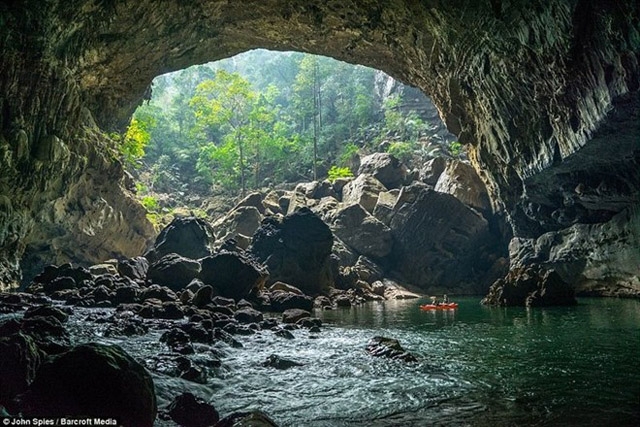
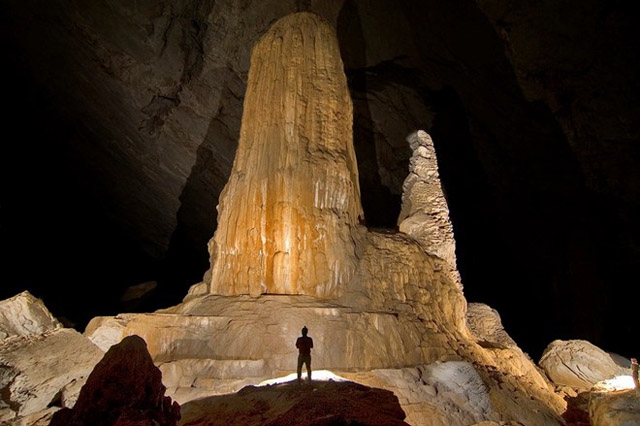
The great cave of Tham Khoun Xe, otherwise known as the Xe Bang Fai river cave, is an underground segment of Xe Bang Fai River situated in a remote corner of Khammuan province.

It was explored by a French team in 1905 and then again in 1995. The cave was relatively unknown except to local people until its re-exploration in 2008 by a national geographic team which has since seen it become widely known internationally.

hang-song-xe-bang-fai-12Picture source: Internet

Based on the expedition report Tham Khoun Xe Cave is considered to be one of the largest sustained river passages in the world with enormous caverns decorated with highly impressive structures.
It originates from the edge of the large mountain chains between Laos and Vietnam. In imagination, following the river, it is seemed that the river disappears into a large channel into the karst mountains. The river flows out again in the large crystal clear water pond near Ban Nong Ping.
The Xe Bang Fai River Cave is almost 11 kilometres in length, some 76 metres high and 56 metres wide.
From the entrance of the cave, we take a boat for 2km and encounter some large rapids.
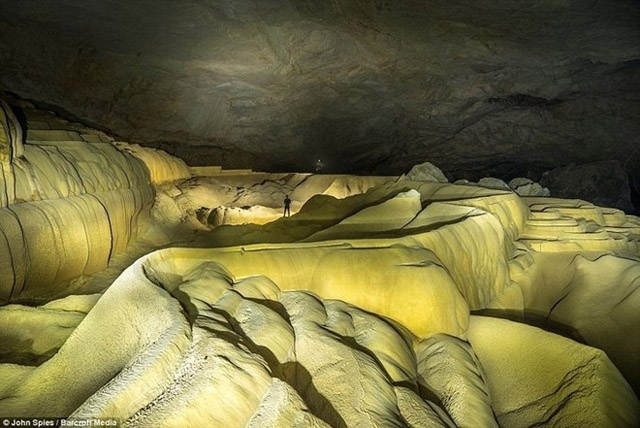
The massive expanse of the cave is decorated with sprout stone and swag stone which is spectacular when illuminated.

The villagers keep this as a prohibited area for fish breeding.
Villagers believe that this area is the source of the Xe Bang Fai river and it is known as “KhounXe Cave” which means the origins of Xe Bang Fai river. Based on the local beliefs, the cave is the living place of the ghost protector to protect the villagers.

hang-song-xe-bang-fai-3Picture source: Internet

It is said that, once upon the time, a villa ger left his broken music instrument at the cave entrance, and the next morning, the instrument was well fixed and usable.
It is also believed that the soul protectors help the villagers if they fall from the cliff while trying to catch swallows and bats near the cave entrance because no one has ever died during a fall. Also, the cave never sustained any bomb damage during the war.
However, the villagers are still not safety aware and do not warn visitors to wear helmets in the cave.
Every year, the villagers hold a ceremony to worship the cave’s soul protectors at the cave entrance, to ensure safety.
However, please do not challenge the traditional beliefs. It is advised to always have a local tour guide from the village to guide you into the cave.

hang-song-xe-bang-fai-6Picture source: Internet

Besides the stunning beauty of the cave itself, the surrounding area is also home to the Hin Nam Nor National Protected Area which is some 82,000 hectares in size. It is a refuge for many species of rare wildlife. Tigers reportedly still roam inside while four species of hornbill have been recorded within the park.
The Hin Nam Nor National Protected Area is now proposed to become a World Heritage site. The Xe Bang Fai River Cave is a part of the protected area. The villagers manage this area for community adventure tours and promote sustainable development in the community.
Besides enjoying the amazing cave, visitors can also enjoying kayaking or rowing on request, instead of using motorised boats, thereby preserving the environment and not disturbing the thousands of bats that live in the cave.
The village boat group provides various tours for visitors including:
The short tour: Visitors can ride a boat inside the cave for 300 metres and climb up to see the cave called the ‘Balcony cave,’ which is similar to the dragon cave. This tour is for visitors who are willing to walk through the mud and climb quite high in to the cave. It takes around an hour.
The long tour: Visitors enjoy a boat ride inside the cave for 2km to where the rapids are and return and stop at the balcony area to see the view and then get back in the boat to ride out into the daylight again.
This tour is for visitors who want to touch the adventure inside the cave and listen to the sounds of the rapids in the dark and then climb up to explore the cave before exiting. It is of medium difficulty and takes around two hours to complete.
Besides the Xe Bang Fai tour, there are other tours that caan be done by bicycle, such as the Bing and Long caves tour. Bing cave is a segment of Xe Bang Fai cave; the entrance is on the mountain on the north side of the of the Xe Bang Fai cave entrance.
The Bing cave entrance is smaller than Xe Bang Fai cave. Inside, we can be amazed by the stalagmites and stalagtites. In the segment area, it is about 700 meters long before opening to the large hall of the cave through which the river flows. Exploring Bing Cave takes about an hour.
Long Cave is located about 300 metres from Nong Ping village. This cave used to contain ancient coffins made of hardwood.
During the war, the cave protected villagers from the bombs, and the northern Vietnamese army who travelled on the Ho Chi Minh trail also sheltered in the cave, which can accommodate thousands of people.
Trekking from Nong Ping village to Long cave takes about 30 minutes.
Visitors are not advised to visit the Xe Bang Fai cave from June to October as it has a strong water flow and can be dangerous. However, the villagers provide other services such as home-stays and village accommodation. Access to tourist sites is more difficult in the rainy season, but they can be accessed all year round by boat from Pak Pha Nang village.

Source: Vientiane Times

Kong Boat Festival – a beauty of Laos Theravada Buddhist culture

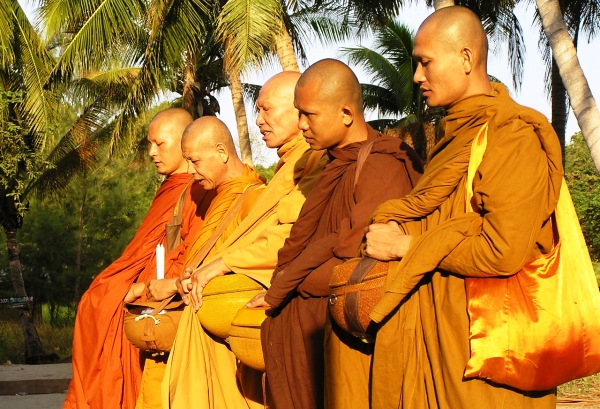
Respectful senior monks and newly ordained monks step over silk sashes placed by merit makers for the monks to step on after they walk from a Naga boat, which is where people pour water over them to wash away any bad spirits. This is the central feature of the Kongbouat festival.
Merit makers at this festival including young and old men and women who sit in a long line from a point close to the Naga boat until the grounds of the sanctuary. Some middle-aged men lay on the ground for the monks to step over their backs, believing the monks will cure their backache.
Merit makers take part in the ordination rituals at the temple and a large group of them invite respectful monks and newly ordained monks to step over their silk sashes, but it’s unlikely that most of them know the meaning of this custom.

OLYMPUS DIGITAL CAMERAVenerable Keo, a senior monk at Sisavangvong temple in Xayaboury district, Xayaboury province, said merit makers offer sashes to respectful monks and newly ordained monks to step over as a sign of respect and to offer their congratulation to monks who are promoted to a new position and have contributed to Buddhist organisations.
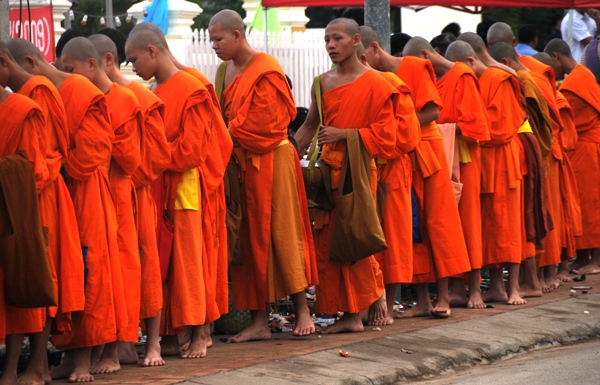
This ritual is in evidence as part of merit making during the Konghote and Kongbouat festivals. When these festivals are observed either in a temple or in someone’s home, the organisers and the monks will decorate a Naga boat while the pathway from the boat to the main worship hall will be adorned with leafy banana stems, sugar cane plants and flowers.
According to Venerable Keo, who is on the temple committee, the Konghote and Kongbouat festivals are held at an appropriate time of the year. This depends on the time that is convenient for those involved, as well as their financial circumstances. There is no limit to the number of festivals that may be held. A large number of people may hold nine Konghote festivals and one Kongbouat jointly. Some people will arrange two or one Konghote and Kongbouat festivals.
Venerable Keo said there are various reasons for holding the Kongbouat festival. Some people do it to ordain a son so that he can study Dharma in the temple and pay tribute to his parents, while others want to pay homage to their deceased parents and other relatives. Elderly people use the occasion as a merit-making ritual as they believe the offerings will support them in the next life. People who arrange a Kongbouat festival are aged over 40. It is considered unacceptable for people under 40 to host the festival because it means they will receive their offerings early and will therefore have a short life.
The festivals last for two days. On the first day the offerings are prepared and on the second day there is an almsgiving ceremony in the early morning and lay people take on the role of Nagas to protect the newly ordained monks. Merit makers and guests form a procession with the four Nagas and offerings and walk to the temple after the almsgiving ceremony.

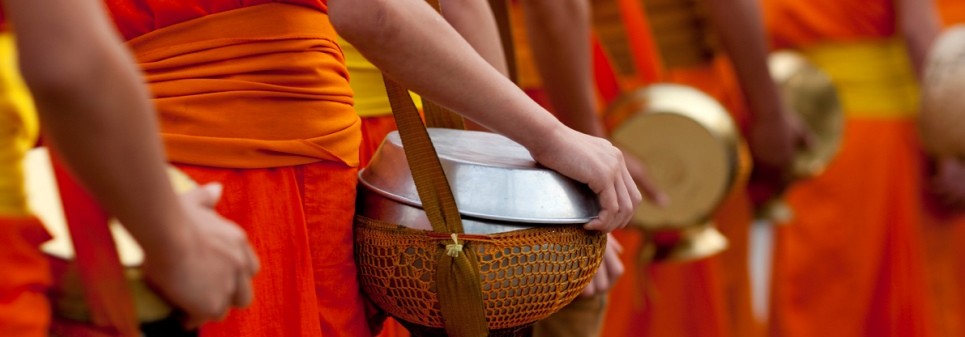
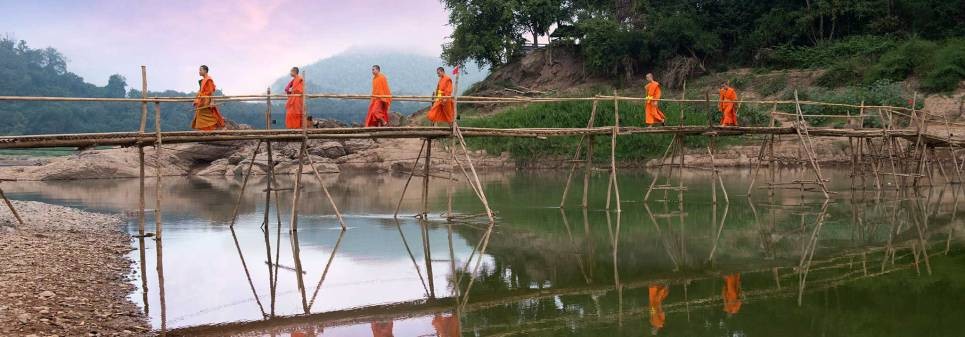
Monks in Luang PrabangOn the first day, friends, relatives and other invited guests come to make merit with the festival organisers and give them money, flowers and milled sticky rice in a bowl. In return, the hosts invite the guests to have lunch and dinner and also give them a bag of snacks. Some guests place offerings in the monks’ bags and bowls. On the evening of the first day, a group of musicians plays traditional music and sings folksongs to entertain the guests.
The second day of merit-making sees the giving of alms, the conversion of people into four Naga and the procession carrying offerings to the temple. When the procession reaches the temple, respectful monks, elderly people, merit makers and the musicians walk three times around the shrine to pay their respects to Lord Buddha.
As the troupe of musicians plays their instruments and sings, participants cheer them to spur them on and create a joyful atmosphere. The merit-makers carry their offerings, comprising a bed, mattress, robes, household utensils and markbeng (a pyramid made of banana leaves, gold paper, flowers, and silver and golden trees hung with kip notes).
After the merit-makers have processed three times around the shrine, the monks begin the religious rituals in the main worship hall to ordain new monks and novices and present offerings.
After the ceremony, the monks who are to be newly ordained, ordained as senior monks or elevated to a higher rank will have water poured over them inside the Naga boat. The merit-makers do this in order to wash away any bad spirits.
The newly ordained monks carry bags and alms bowls from the Naga boat to the main worship hall. Some monks throw sacred water over the participants while some merit-makers throw money mixed with candy, milled sticky rice and flowers.
Merit-makers then invite monks from other temples and the organisers of the Kongbouat festival to take part in a Baci ceremony for the newly ordained monk. The hosts of the festival offer a bowl containing pieces of silver and golden swords to the monk.
Venerable Keo said these items are considered to be a show of support for the monk. The monk is not allowed to sell them, but may give them to someone he holds dear.
There is no limit to the weight of the silver and golden swords given to the monk. The amount given depends on the festival organiser.
The Konghote and Kongbouat festivals are similar, but the Konghote doesn’t involve the presentation of pieces of silver and golden swords.
Invited guests and all laypeople taking part in the merit-making, both at home and in the temple, will wear modest clothing. Women of course wear a sinh (long skirt) and blouse, while men wear trousers.

Source: By Phon Thikeo , Vientiane Times